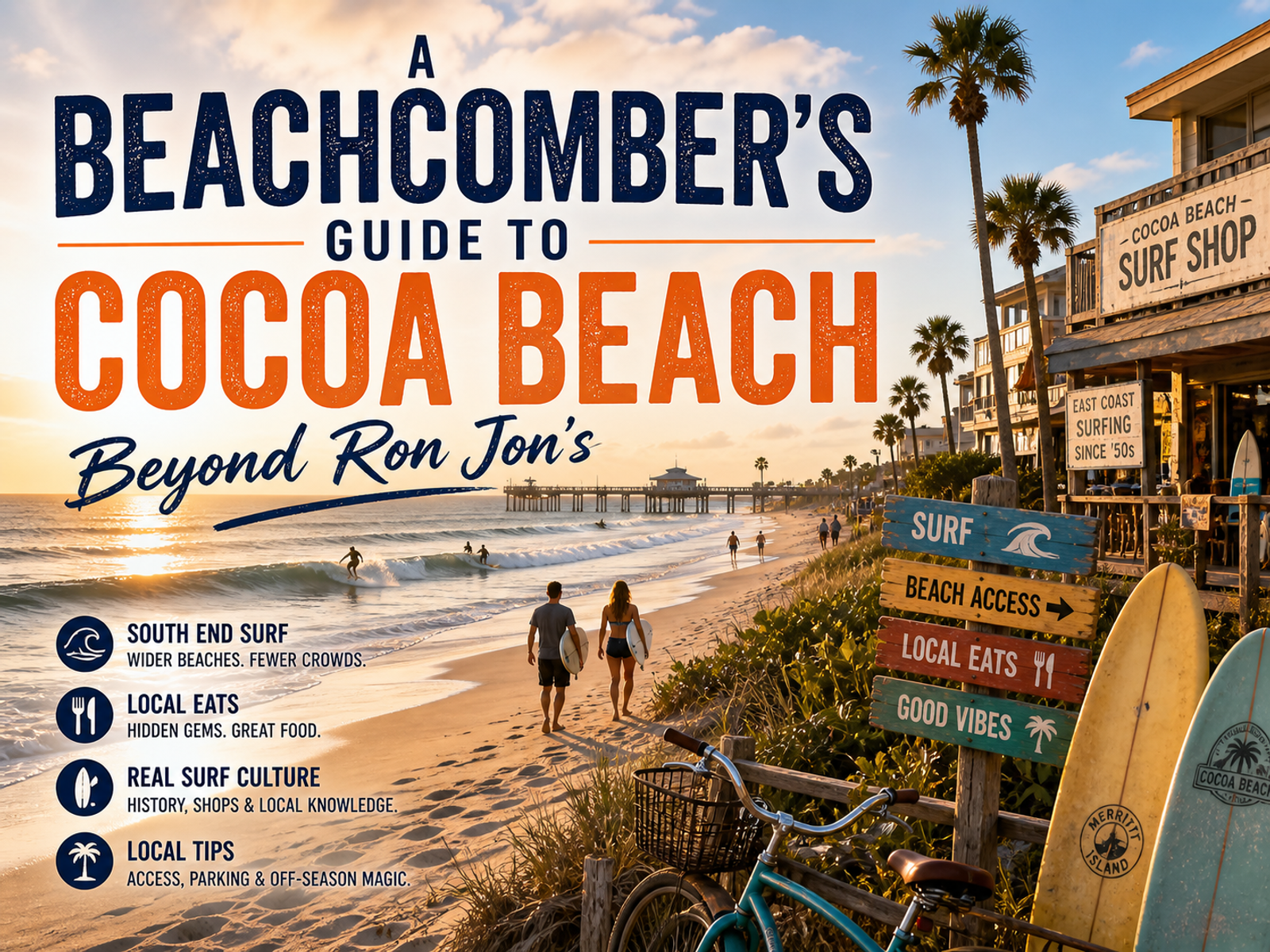
Ron Jon Surf Shop is fine. It is genuinely, legitimately fine — a 52,000-square-foot retail landmark that has been open 24 hours a day since 1959 and has sold more beach towels than any institution in the state of Florida. If you need a t-shirt, a boogie board, or a reason to keep the kids busy for 45 minutes, it delivers on all counts.
But Cocoa Beach is not Ron Jon’s, and treating it as such is the mistake that most first-time visitors make and most repeat visitors quietly correct. The real Cocoa Beach — the one that locals actually inhabit, that surfers have been returning to for decades, that gives the town its texture and its stubbornness — exists in the blocks around it, in the south end, in the side streets, in the places that don’t have a reader board on A1A.
This is a guide to that Cocoa Beach.
Start in the South End
The section of Cocoa Beach that most visitors never reach runs south of the main commercial strip, roughly from the Minuteman Causeway toward the Brevard County line. The beach here is wider, the parking is easier, and the crowd thins to something approaching actual solitude on weekday mornings.
The south end is where the longboarders go in the morning, before the wind picks up and the conditions turn choppy. The break here is mellower than what you find up near the pier — better for intermediate surfers and for anyone who wants to get in the water without fighting for position. If you’re watching rather than surfing, the walk from the south end public access points down the shoreline at low tide is the best beachcombing stretch in town.
The Pier, Done Correctly
Everyone goes to the Cocoa Beach Pier. The mistake is treating it as a destination rather than a vantage point. The pier itself is worth walking for the perspective it gives you — you can see the coastline north toward Cape Canaveral and south toward Satellite Beach from a position about 800 feet into the Atlantic — and for the way it concentrates whatever swell is running.
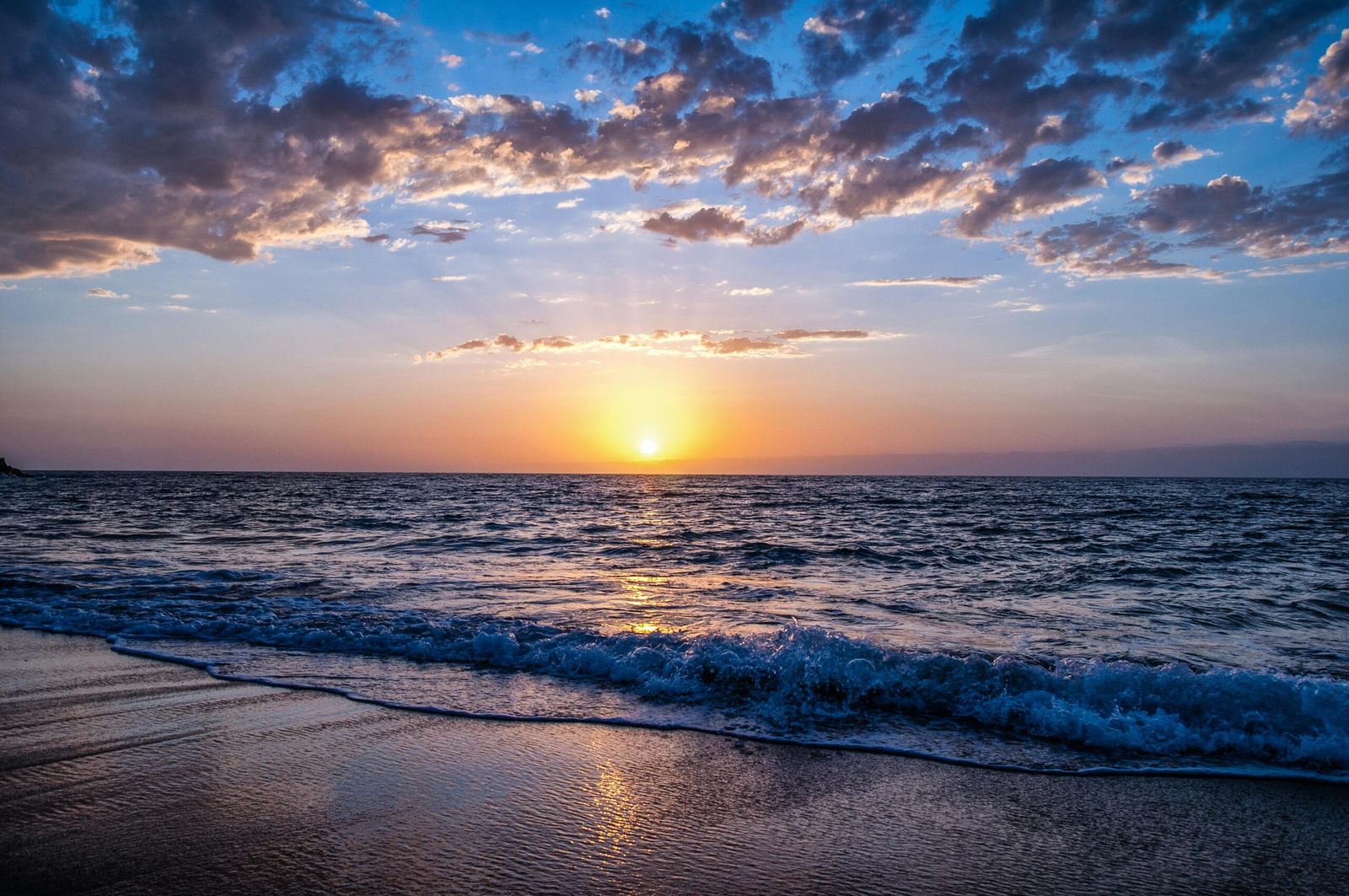
The best time to be on the pier is early morning during an east swell, when the light is flat and the water is glassy and the surfers below are working sets that look small from above and feel large from below. This is also, practically speaking, when parking is easiest, crowds are thinnest, and the attached restaurant is serving breakfast.
Where to Actually Eat
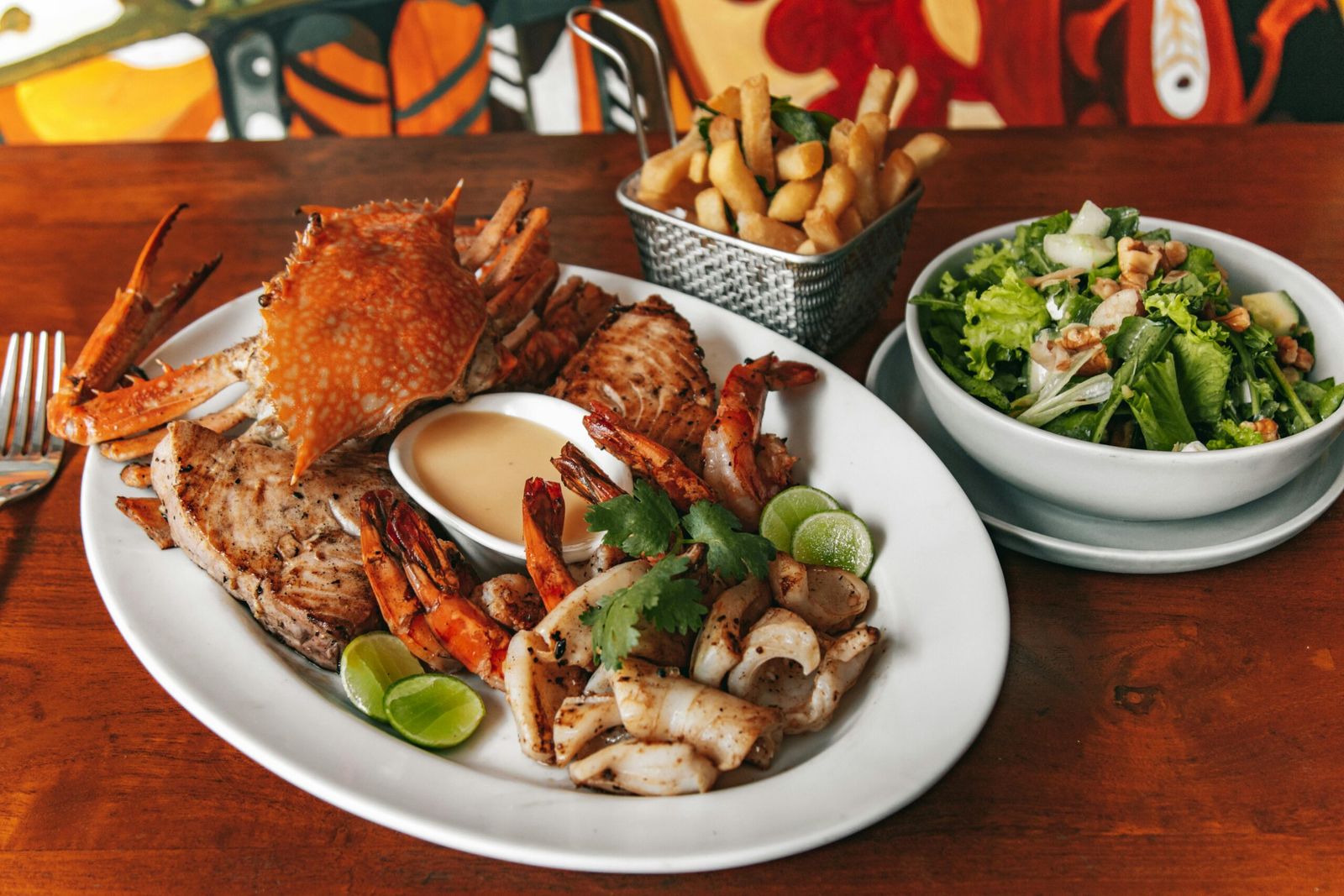
The best food in Cocoa Beach exists in inverse proportion to its visibility from A1A. A few places worth knowing:
Coconuts on the Beach sits directly on the ocean and has been there long enough that it’s earned its worn edges — this isn’t a place that’s pretending to be a beach bar, it is one, and the difference is tangible in the service, the clientele, and the quality of the fish tacos. Go for lunch, sit on the upper deck, and watch whatever surf conditions happen to be running.
For breakfast, the local standard is Alma’s Italiano, which sounds like it should be serving pasta but has been doing a full American breakfast to the surf community since the 1970s. It is small, cash-favored, and exactly as unglamorous as the name suggests. It is also very good.
The no-name restaurants on the side streets off A1A — and there are more than you’d expect — are generally the better bet for dinner than anything with a prominent sign on the main drag. The ones that have survived without foot traffic from tourists have done so because the locals kept coming back.
The Side of Surfing that doesn’t have Merchandise
Cocoa Beach is, in the technical sense, one of the birthplaces of American surfing culture. Kelly Slater grew up here. The 2024 Summer Olympics featured surfing for the first time, and at least two competitors trained in Brevard County.
None of this is particularly visible in the town’s tourist infrastructure, which tends to sell the aesthetic of surfing rather than the sport. The actual surf culture here is older, more specific, and more interesting. The Cocoa Beach Surf Museum — a modest institution operating inside a local shop — documents the history of East Coast surfing in a way that national surf media consistently overlooks. It’s worth an hour.
The surf shops that serious surfers use are not Ron Jon’s. They are smaller, staffed by people who surf every day, and willing to give you specific, honest advice about conditions, gear, and where to be on any given morning. Merritt Island Surf Shop and Hot Wax Surf Shop are both better stops if you’re actually trying to get in the water.
What the town looks like when it’s not summer
Most visitors see Cocoa Beach in peak season, when the population swells and the town is performing a version of itself for an outside audience. The version of Cocoa Beach that exists from October through April is quieter, more itself, and in most ways more enjoyable.
The restaurants are less crowded. Parking is free and plentiful. The water temperature stays in the low 70s through the winter — cold by Florida standards, comfortable by anyone else’s. The surf community is year-round and visibly present in a way that gets diluted by summer.
If you can visit in November or March, you’ll find a town that isn’t bracing for the season. You’ll also find the version of Cocoa Beach that the people who live here actually like.
A practical note on beach access
Cocoa Beach has public beach access points approximately every few blocks along A1A. The ones with parking meters are the ones visitors find; the ones without are the ones locals use. The street-end accesses — unmarked, minimally maintained, occasionally sandy-floored and difficult to pull into — offer the most solitude and the easiest parking. On a map, they appear as dead-end streets terminating at the beach. In practice, they are the town’s best-kept non-secret.