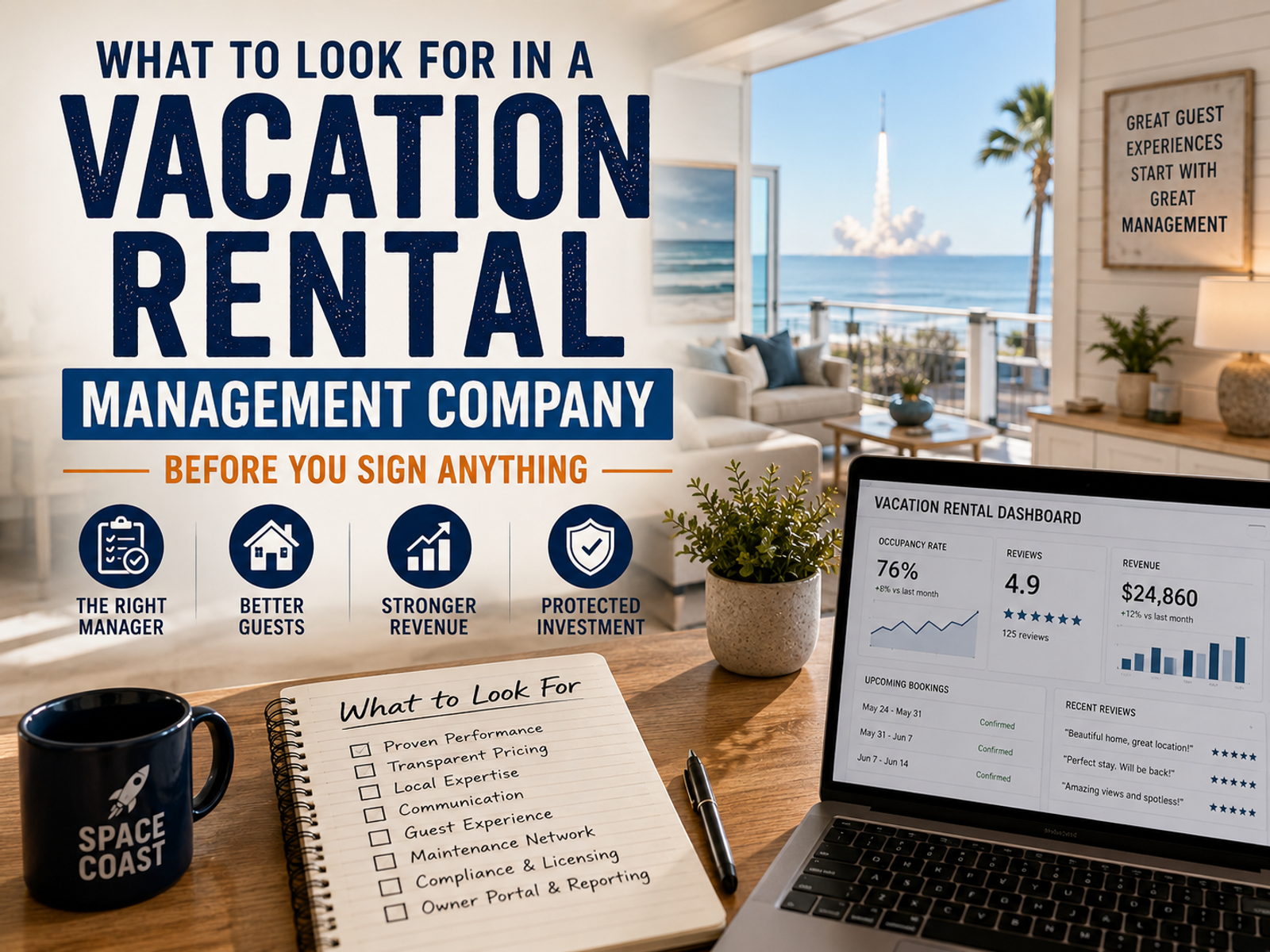
If you own property on the Space Coast and you’re considering putting it into the short-term rental market, the decision you’ll make next is arguably more important than any amenity upgrade, any renovation, or any pricing strategy: who’s going to manage it.
The vacation rental management industry has matured considerably in the last decade, but it remains unevenly professionalized. There are excellent operators in this market and there are mediocre ones, and the gap between them — measured in owner revenue, guest satisfaction, and property condition — is not small. The challenge is that from the outside, they tend to look similar.
This is a guide to telling them apart.
What a Good Manager Actually Does
Before evaluating anyone, it helps to have a clear picture of what’s genuinely involved in professional vacation rental management. It’s more than most first-time rental owners expect.
On the guest-facing side: channel management across multiple booking platforms, optimized listing creation and photography, dynamic pricing that adjusts rates in real time based on demand and competitive data, guest communication from inquiry through checkout, damage assessment and deposit management, and review response.
On the property side: coordinating professional cleaning between every stay, managing a network of maintenance vendors across plumbing, HVAC, appliances, and landscaping, conducting regular property inspections, tracking consumable supplies, and handling the inevitable 11pm call about something that stopped working.
On the compliance side: keeping up with Brevard County’s short-term rental regulations, ensuring proper licensing and permitting is maintained, managing tax collection and remittance, and staying current as ordinances change.
A management company that’s doing all of this well is genuinely providing value that’s difficult to replicate independently. A company that’s nominally doing all of this — that claims to be doing all of this — while actually providing thin service is a significant liability.
Here’s how to tell the difference.
Questions Worth Asking Before you Sign
How do you handle maintenance requests, and what’s your response time standard?
The answer you want is specific: a named after-hours contact, a defined response time (not “as soon as possible”), and a clear process for emergency vs. non-emergency issues. Vague answers here are a meaningful signal.
Who are your preferred vendors, and are they local?
National franchise vendors — the HVAC chains, the big cleaning services — often struggle with the service-speed requirements of vacation rental management, where a cleaning gap of a few hours translates directly to delayed check-ins and unhappy guests. Local vendors with established relationships tend to perform better in this specific context. Ask who they use and how long those relationships have been in place.
How do you price properties, and can I see an example?
Dynamic pricing — adjusting nightly rates based on demand signals, local events, competitor data, and booking window — is the industry standard. If a company is setting a rate and leaving it alone, they’re leaving money on the table in peak periods and failing to fill the calendar in slow ones. Ask to see how their pricing has performed for a comparable property over the last 12 months.
What’s your average occupancy rate for properties like mine?
Be specific: not their average across all properties, but for properties comparable to yours in location, size, and amenity set. Ask for a range, ask about seasonality, and ask what differentiates their best-performing properties from their worst.
How do you handle guest damage?
The answer here involves several components: the security deposit structure, whether they use a damage waiver program, what the claims process looks like, and how disputes with guests are handled. The gap between policies on paper and actual practice can be wide — ask for a specific example of how a damage claim was handled recently.
What does your management fee cover, and what doesn’t it?
Management fee structures vary: flat percentage, tiered percentage, per-booking fees, maintenance markups, credit card processing fees, supply restocking fees, and annual fees all appear in various combinations. Get a clear picture of the full cost structure, not just the headline number. A 15% management fee that includes everything may be better or worse than a 12% fee that doesn’t.
How do you communicate with owners, and how often?
Monthly statements are the minimum. Good operators provide real-time owner portals with booking data, revenue, and maintenance logs — and proactively communicate anything that requires owner input. Ask specifically: if something comes up between statements, how does the communication work?
🚩Red Flags🚩
A management company that is reluctant to provide references from current owners is a significant red flag. Not former owners — current ones, who are actively receiving revenue and dealing with whatever service quality the company is currently providing.
A company that can’t clearly explain their pricing methodology, or who quotes you a revenue estimate without supporting data, is either inexperienced or optimistic in ways that may not survive contact with reality.
A contract that makes it difficult to exit — long terms, steep early termination penalties, requirements that properties remain exclusive to their platform — is worth reading carefully. Confidence in service quality should make aggressive retention clauses unnecessary.
What a Good Fit Feels Like
The intangible worth paying attention to: does this feel like a company that’s managing a portfolio of properties, or one that genuinely knows the Space Coast and has an investment in how it’s represented to guests?
The Space Coast has a character — its launch culture, its wildlife, its particular mix of working waterfront and resort beach — that the best local operators understand and communicate. That understanding shows up in listing copy, in how they set guest expectations, in what they recommend to guests, and in the relationships they’ve built with the community that makes the area worth visiting.
That’s not something you can ask about directly. But it comes through when you visit a property they manage, talk to their current owners, or read the reviews their properties are generating.
It’s worth taking the time to find it.