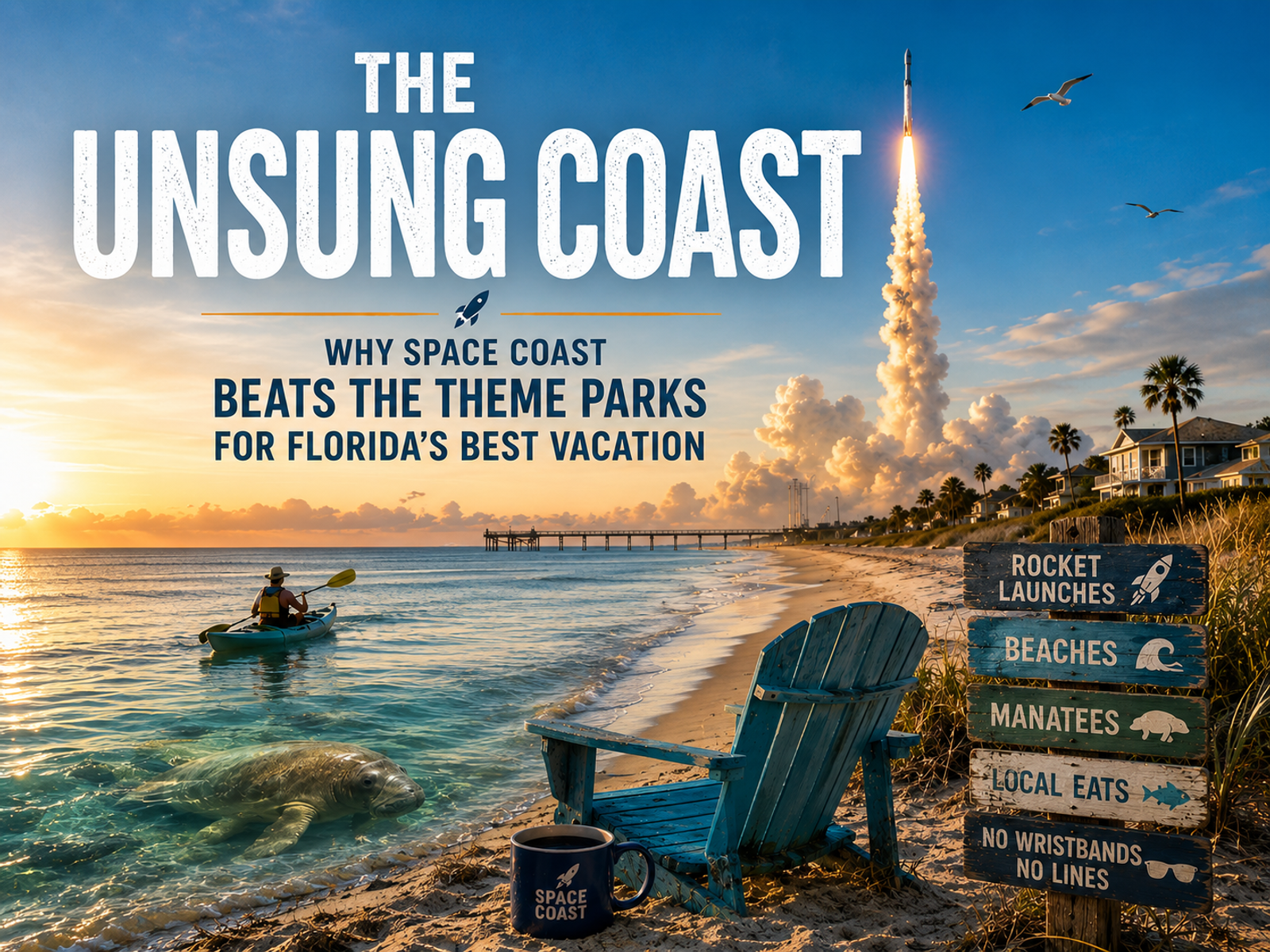
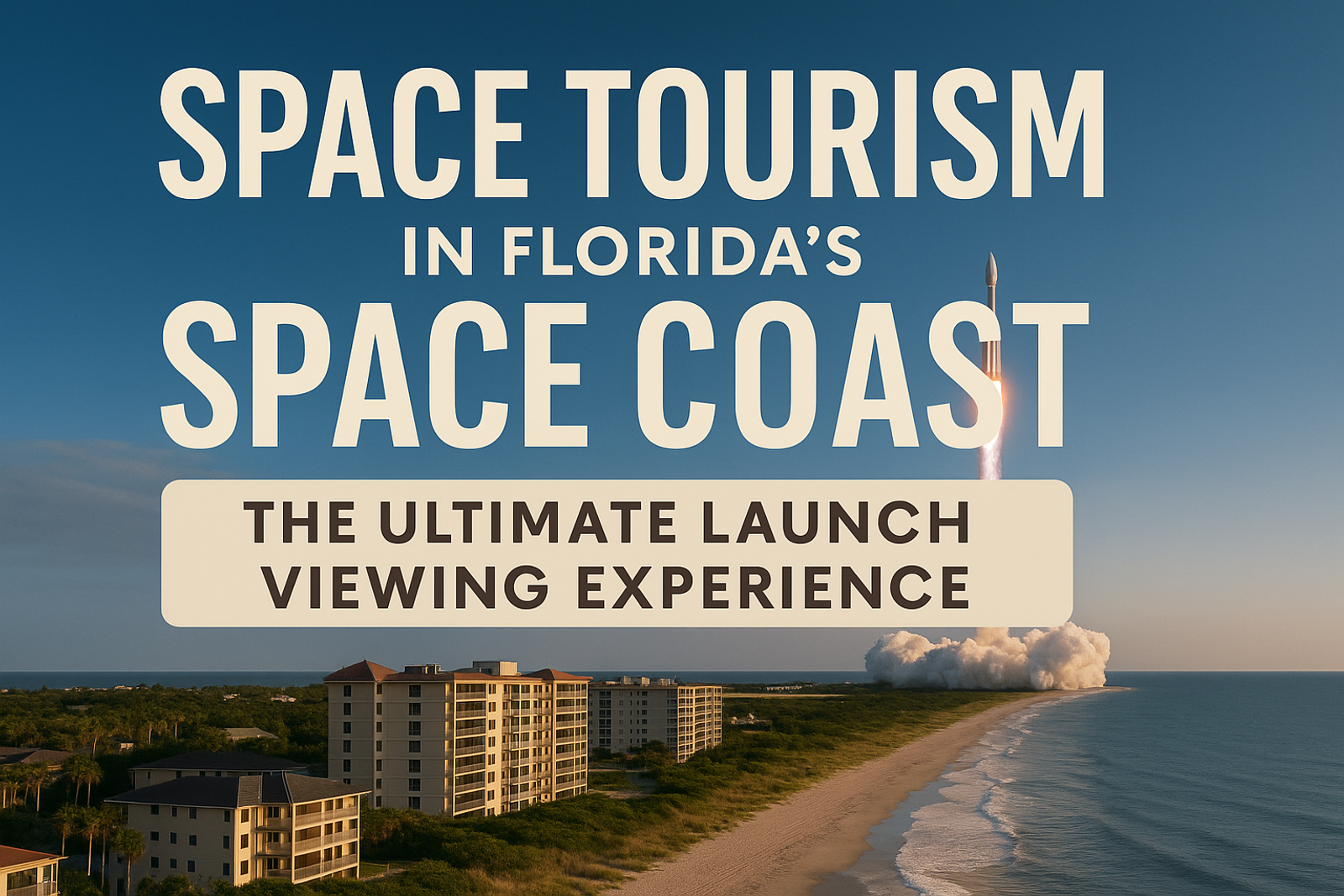
There’s a version of Florida that most people never find. It’s not behind a turnstile. There’s no parking structure, no wristband, no $22 cheeseburger. It’s a 72-mile stretch of Atlantic coastline where the highways run beside salt marshes, where manatees drift under public boat ramps, and where on any given morning you might watch a rocket punch through the clouds from a beach chair you dragged down yourself.
That’s the Space Coast. And for reasons that have more to do with marketing than reality, it sits quietly in the shadow of a state that has spent decades convincing visitors that Florida’s best experiences require a ticket.
They don’t.
The math nobody talks about
Let’s be direct about what a central Florida theme park vacation actually costs a family of four. By the time you’ve covered park admission, parking, resort lodging, and meals inside the gate, you’re looking at $3,000 to $5,000 for three or four days before you’ve bought a single souvenir. That’s not a criticism — those parks deliver genuine experiences and millions of people love them. But it’s worth holding that number up against what the same budget looks like 45 minutes east on the 528.
A week in a beach house in Cocoa Beach or Satellite Beach — with a full kitchen, a yard, direct beach access — typically runs $1,500 to $2,500 in peak summer season. The Atlantic Ocean is free. The Indian River Lagoon is free. Watching a rocket launch from the beach is free. The difference isn’t just financial. It’s the difference between consuming an experience and actually having one.
What the Space Coast actually is
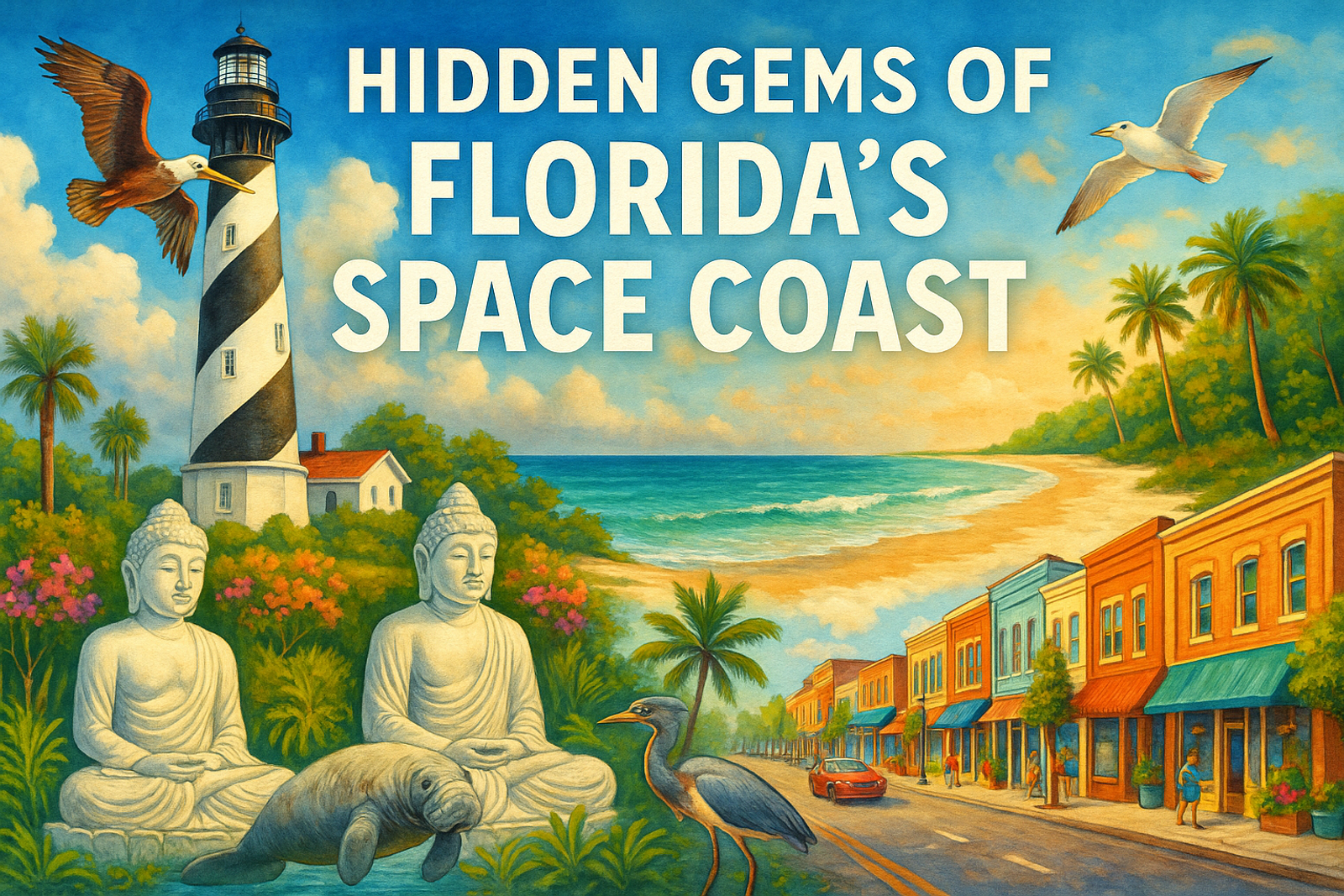
The region stretches from Titusville in the north — the town closest to Kennedy Space Center — south through Cape Canaveral, Cocoa Beach, Satellite Beach, Indian Harbour Beach, Indialantic, and Melbourne Beach. Each has its own character. Cocoa Beach is the most commercial, with surf shops and the famous Ron Jon’s anchoring its main strip. Satellite Beach is almost entirely residential, the kind of town where the only reason to stop is because you live there. Indialantic and Melbourne Beach feel like the coast the rest of Florida forgot — quiet, local, uncommercial.
Running parallel to the Atlantic, separated from it by a ribbon of barrier island, is the Indian River Lagoon — one of the most biodiverse estuaries in North America. The lagoon holds more species of fish than any other estuary in North America, supports year-round populations of bottlenose dolphins and West Indian manatees, and during certain seasons transforms its water into something that has to be seen to be believed: a bioluminescent kayaking experience where every paddle stroke lights up the water around you in electric blue.
To the north, Merritt Island National Wildlife Refuge shares a fence line with NASA’s launch facilities and holds more threatened and endangered species than any other refuge in the continental United States. It is genuinely extraordinary, and genuinely unknown outside the birding community.
The launch variable
Here is the thing about the Space Coast that no other Florida destination can claim: on any given visit, something might launch.
It might be a Falcon 9 from SpaceX, hauling a Starlink constellation into orbit. It might be a United Launch Alliance rocket carrying a military payload. It might be a crewed mission heading to the International Space Station. Whatever it is, the moment a rocket clears the pad at Kennedy Space Center or Cape Canaveral Space Force Station, the entire coast — everyone on every beach, at every restaurant patio, in every backyard — stops what they’re doing and watches.
You can watch it from a beach blanket. You can watch it from a kayak on the Banana River. You can watch it from your rental’s back porch with a coffee in your hand. The experience of seeing a vehicle the size of a 20-story building disappear into the sky on a column of fire and smoke is something that genuinely does not get old, and it costs nothing.
What to actually do here
Without pretending to be exhaustive about it: the Space Coast is best experienced slowly. The instinct, especially for visitors conditioned by theme park vacations, is to fill every hour. That instinct is worth resisting.
The mornings here are for the water. Surfing is best in Cocoa Beach and just south of the Sebastian Inlet, an hour’s drive down A1A. Paddleboarding and kayaking are best on the lagoon side, where the water is calm and the wildlife is dense. Fishing — surf fishing, pier fishing, backcountry fishing in the lagoon’s shallow flats — is available in enough variety that you could spend an entire week on it without repeating yourself.
The afternoons, when the sun is highest and the beach is most crowded, are when the Space Coast reveals another advantage: its infrastructure of small restaurants, local breweries, dive bars, and coffee shops is genuinely good and almost entirely devoid of chains. There’s a craft brewery culture here that runs from Titusville down to Melbourne Beach that most visitors never find.
The evenings are for the beach, for watching the light change over the Atlantic, and for checking the launch schedule.
Who the Space Coast is for
The honest answer is that it’s not for everyone, and that’s part of what makes it worth talking about. If you need a schedule, a plan, a set of curated experiences to move through — there are better places for that. But if what you’re actually looking for is a week where the kids can be genuinely, freely outside; where the pace is set by tides and launch windows rather than FastPass availability; where the food you’re eating was likely caught within sight of where you’re sitting — then the Space Coast offers something that’s increasingly hard to find anywhere in Florida.
It doesn’t need much help. It just needs to be found.