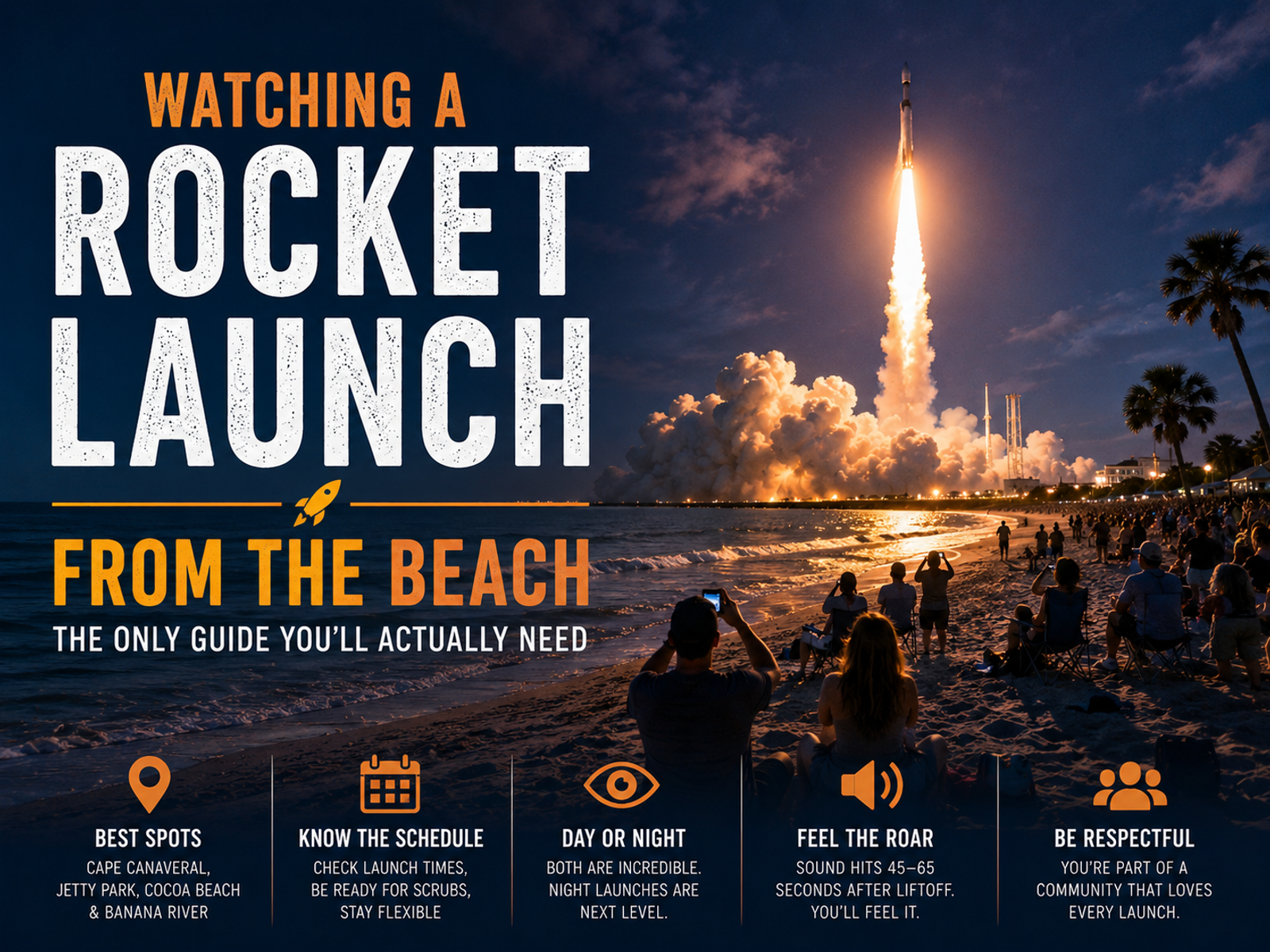
There are two kinds of people on the Space Coast when a rocket launches: the ones who knew it was coming and positioned themselves, and the ones who happened to be outside and still, somehow, got something they’ll talk about for years.
This guide is for the first kind. But if you’ve had the second experience — if you once stepped onto a balcony for a cup of coffee and watched a Falcon 9 make its way silently and then not-silently into the sky — then you already understand what we’re talking about, and this will help you do it properly next time.
The Honest Answer about Viewing Locations
Kennedy Space Center sells a launch viewing experience. It is legitimate, it includes amenities and commentary and a particular closeness to the launch site, and it costs $50 to $80 per person depending on the mission. If you have never seen a launch before and money isn’t the primary consideration, it’s a fine choice.
But it is not the best choice, and it is not how the people who live here watch launches.
The best launch viewing on the Space Coast is free, requires no advance ticket, and puts you in the company of thousands of local residents who have figured out the same thing: for the dramatic, visually overwhelming, physically felt experience of a rocket launch, beach access north of Cocoa Beach is where you want to be.
Here’s why: the launch pads at Kennedy Space Center and Cape Canaveral Space Force Station are positioned such that rockets travel northeast over the Atlantic. From a beach position between Cocoa Beach and the KSC Visitor Complex — the beaches of Cape Canaveral, Jetty Park, or the north end of Cocoa Beach — you get a viewing angle that tracks the vehicle for its entire visible ascent. You’re roughly 6 to 12 miles from the pad, close enough to feel the sound arrive in your chest several seconds after the visual, distant enough to see the full arc of the trajectory against the sky.
The KSC viewing experience puts you closer. It also puts a building between you and the sky. The beach puts nothing between you and the sky.
The Specific “Hot” Spots
Jetty Park in Cape Canaveral is the closest public beach access to the launch pads with free vehicle access (the park charges a nominal entry fee, currently $15 per vehicle). It fills early for high-profile launches — plan to arrive two to three hours before liftoff for prime positioning. The view is excellent, the park has restrooms, and the atmosphere for major launches is genuinely electric.
The public beach access on A1A north of Cocoa Beach — the stretch of Cape Canaveral coastline running from roughly George King Boulevard north — offers similar angles with more dispersed crowds. The parking situation requires more effort but the tradeoff is space and a less organized, more spontaneous feel.
The Banana River shoreline on Merritt Island gives you a different perspective: you’re watching from the lagoon side, with the actual pads visible across the water. For daylight launches this can be visually stunning — the reflection on the water, the angle of the plume. For night launches, which are in a separate category of spectacle entirely, it is extraordinary.
Exploration Tower in Port Canaveral offers a rooftop viewing deck that has become one of the better landside platforms for launches from the northern pads. It’s a solid option if you prefer an elevated perspective or if you’re combining the visit with time at the port.
When Are Launches Happening? Here’s How To Tell
The most reliable source is the Space Launch Delta 45 public affairs schedule, available online, which lists confirmed and tentative launch windows. Space Launch Schedule and Launch Library are both good aggregator sites. For last-minute planning, the Brevard County launch status line provides a recorded update.
Here’s what matters practically: launch windows are specific, often just one or two minutes long within a multi-hour “window,” and scrubs are common. A scrub — where the launch is called off due to weather, technical issues, or range conflicts — can happen at any point from the night before to T-minus 30 seconds. Anyone who tells you launches run reliably on schedule has not spent much time watching launches.
Plan for flexibility. If you’re staying for a week, you’ll likely have multiple opportunities. If you’re in for a weekend and a specific launch matters to you, have a backup activity for the evening.
Night Launches: Plan Accordingly
Daytime launches are spectacular. Night launches are in a different category.
The flame from a rocket engine is, in the daylight, bright but contextually legible — it’s fire against a sky. At night, it is different. The pad area illuminates. The vehicle itself is invisible until ignition, when it appears as a sudden, violent point of light that grows and rises and moves. The plume expands in ways that daylight hides. The cloud of exhaust catches the illumination and hangs over the coast in shapes that are genuinely eerie.
For night launches, give your eyes time to adjust. Get away from artificial light sources. If you’re on the beach, get away from the parking lot lights. The full experience of a night launch requires darkness, and the Space Coast — particularly on the barrier island beaches north of Cocoa Beach — offers plenty of it.
The Sound
The visual is why people show up. The sound is why they don’t forget it.
Sound travels at roughly one mile every five seconds. From 8 to 12 miles away, you’ll feel the sound arrive approximately 45 to 65 seconds after liftoff. It’s not a sharp crack — it’s a sustained, physical pressure that starts low and builds and is felt in the sternum more than heard through the ears. People who have never experienced it describe it afterward as something they didn’t expect — not loud, exactly, but present in a way that is hard to describe without sounding dramatic.
You cannot approximate this experience from a hotel room or a restaurant. You need to be outside, preferably away from buildings, on a night with no strong wind. The beach, again, is optimal.
A Brief Note On Etiquette
The people around you have also been waiting, possibly for hours, in some cases after a scrub the night before. The launch window, when it opens, tends to produce a silence that precedes the roar — an instinctive collective quiet as the vehicle becomes visible. Respect it.
And if, by chance, you’re on the beach with someone for whom this is their first launch — do them the favor of not narrating. Let them have it.