If you own a vacation rental on the Space Coast and you’re managing it yourself, you’ve probably run the mental math on property management fees and concluded that keeping the money makes more sense than paying someone a percentage of your revenue to do things you could theoretically do yourself.
This is a reasonable starting position. It is also, for most owners, wrong — not because property management fees are trivial, but because the math most owners run is incomplete.
The complete version of the math is harder to do and less flattering to the DIY case. This is an honest attempt at it.
What the fee looks like on paper
Full-service vacation rental management on the Space Coast typically runs between 20 and 30 percent of gross rental revenue, depending on the operator, the service scope, and the property. On a property generating $40,000 in annual gross revenue, that’s $8,000 to $12,000 per year.
That number, in isolation, looks significant. Measured against what it actually buys, it tends to look different.
The Time Cost 🕒
The most consistently underestimated component of self-management is time — specifically, the ongoing, non-optional, irregularly-distributed time that vacation rental management actually requires.
Guest communication alone runs heavier than most owners expect. Inquiries, pre-booking questions, check-in instructions, mid-stay issues, checkout reminders, and post-stay follow-up for a property running at reasonable occupancy can average 45 minutes to an hour per booking, across all touchpoints. At 30 bookings per year — modest for a well-performing Space Coast property — that’s 25 to 30 hours annually in communication alone, distributed across evenings, weekends, and vacations without regard for your schedule.
Add to that: coordinating cleaning between every stay, handling maintenance issues as they arise (which they will, unpredictably, including outside business hours), conducting property inspections, managing supplies, updating listings across platforms, and monitoring and responding to reviews.
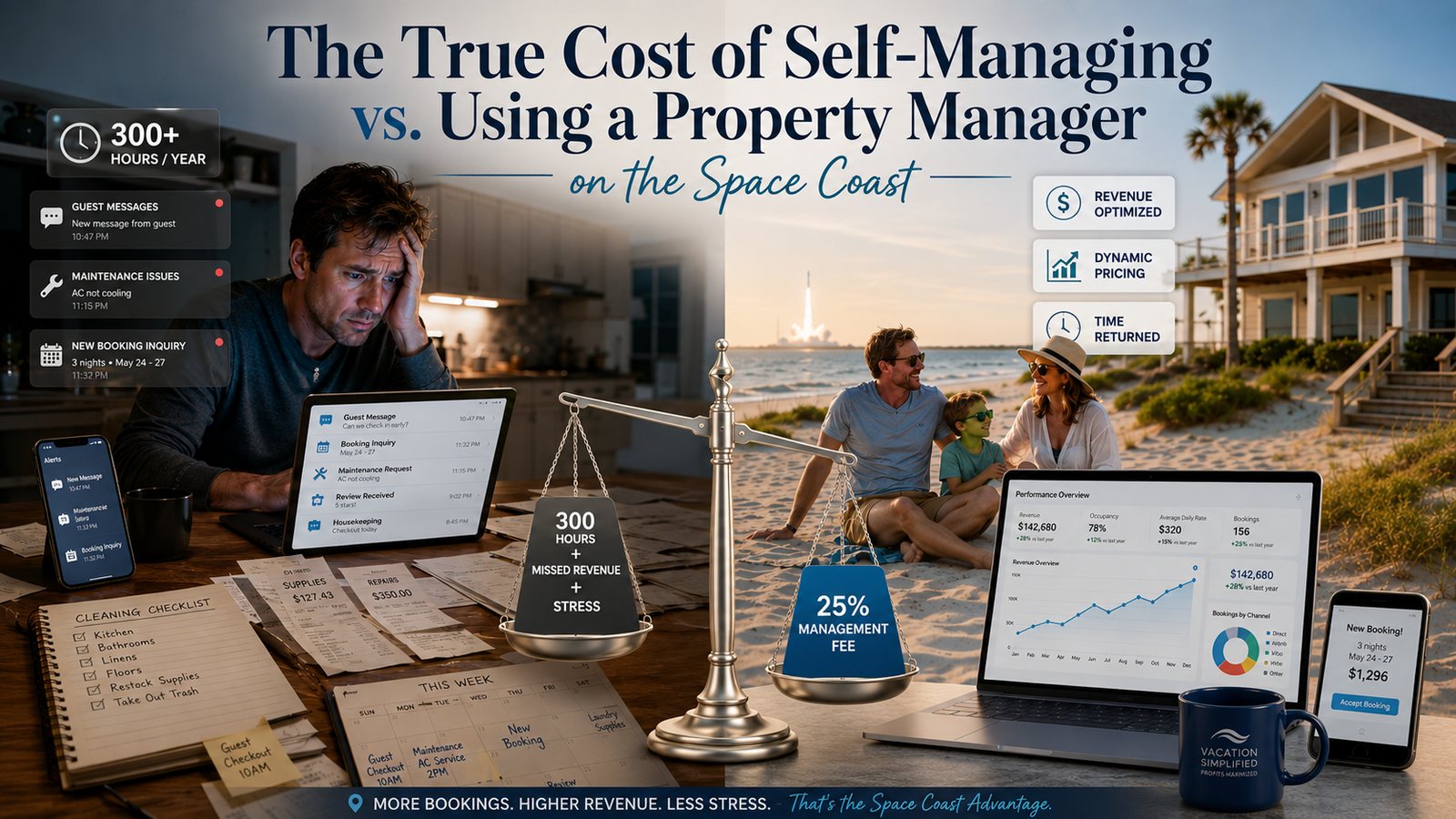
A realistic accounting of the time required to self-manage a single vacation rental property is 200 to 400 hours per year for a reasonably well-run operation. At a conservative estimate of your time’s value — $50 per hour is low for most professionals — that’s $10,000 to $20,000 in time cost annually, before accounting for the value of the specific evenings, Saturdays, and family dinners the phone interrupts.
The Revenue Gap 💵
The more complicated comparison is revenue performance. Self-managed properties and professionally managed properties on the same coast, in equivalent locations, do not typically perform the same on gross revenue, and the gap tends to favor professional management by a margin that more than covers the management fee.
The primary drivers are Pricing and Distribution:
Dynamic Pricing — adjusting nightly rates based on real-time demand signals, competitor data, local events, booking window trends, and platform algorithms — requires both tools and expertise that most individual owners don’t have. A self-managed property using static or manually adjusted pricing typically leaves 10 to 20 percent of available revenue on the table during peak demand periods, and fails to optimize occupancy in shoulder seasons through strategic rate reduction.
Distribution — the number of platforms your listing appears on, how well it’s optimized for each platform’s algorithm, and whether it’s appearing in the right search results for the right traveler profiles — matters enormously for occupancy. Professional managers maintain optimized listings across Airbnb, VRBO, Booking.com, and direct booking channels simultaneously, with photography and copy calibrated for each.
On a $40,000 gross revenue property, a 15 percent revenue improvement from better pricing and distribution is $6,000 — nearly enough to cover a management fee entirely, before you’ve counted a single hour of your own time.
The Liability and Compliance Cost
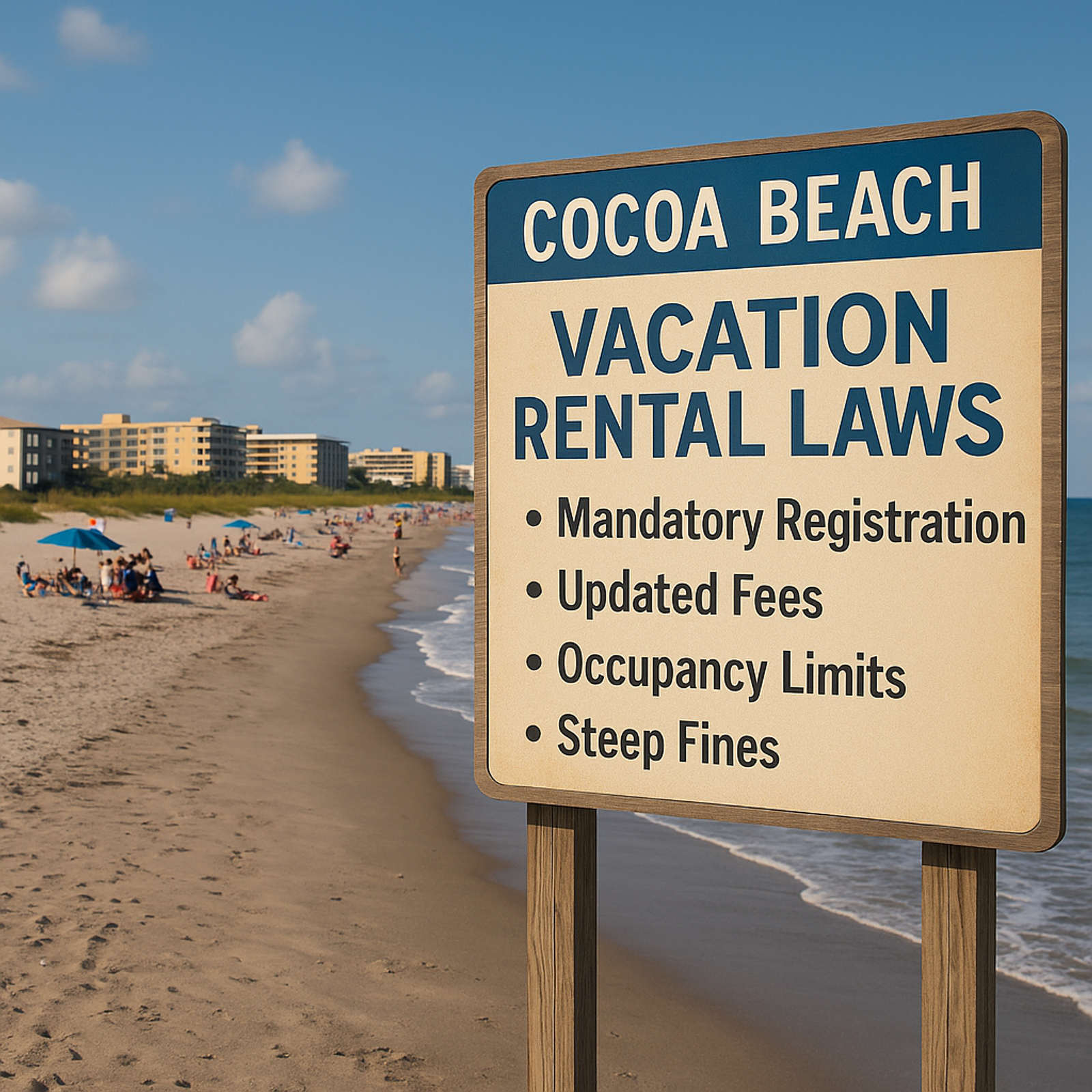
Brevard County’s short-term rental regulatory environment has evolved, and it continues to evolve. Business tax receipts, tourist development tax collection and remittance, compliance with Florida’s vacation rental statutes, and in some municipalities additional permitting requirements all fall on the property owner.
Non-compliance isn’t theoretical. Fines for operating without proper licensing or failing to remit tourist development taxes are real and periodically enforced. Keeping current with regulatory changes requires active monitoring that most self-managing owners don’t have the bandwidth to maintain consistently.
Professional managers handle this as a baseline function. The cost of a single compliance issue — or a single significant guest dispute that escalates without professional management in place — can dwarf months of management fees.
The Honest Comparison
Take a Space Coast property generating $45,000 in gross annual revenue:
Self-managed, with a static pricing approach: gross revenue of approximately $45,000, minus roughly $8,000 in platform fees (Airbnb and VRBO combined), minus the owner’s 300 hours of management time valued at $50/hour ($15,000), minus the cost of compliance errors or maintenance misses, minus the opportunity cost of missed revenue from suboptimal pricing. Net value after time cost: roughly $22,000.
Professionally managed, with dynamic pricing and full-service management: gross revenue potentially $48,000 to $52,000 given better pricing optimization, minus a 25% management fee ($12,000 to $13,000), with zero owner time required. Net value to the owner: $35,000 to $39,000 — plus the return of 300 hours per year.
The fee is real. The value it delivers, when the management is genuinely good, is larger.
The Question Worth Asking
The relevant question isn’t whether professional management costs money. It clearly does. The relevant question is: what are you actually buying with the money you’re keeping by self-managing, and is it worth the true cost of keeping it?
For some owners, the answer is yes — they enjoy the hands-on involvement, they have the time, and the financial comparison is close enough that the preference for control tips the balance. That’s a legitimate choice.
For most owners who are honest about their time, their stress tolerance, and the revenue they’re not capturing, the math points in a different direction.
Want a revenue estimate for your specific property? We’re happy to run the numbers — no commitment required.